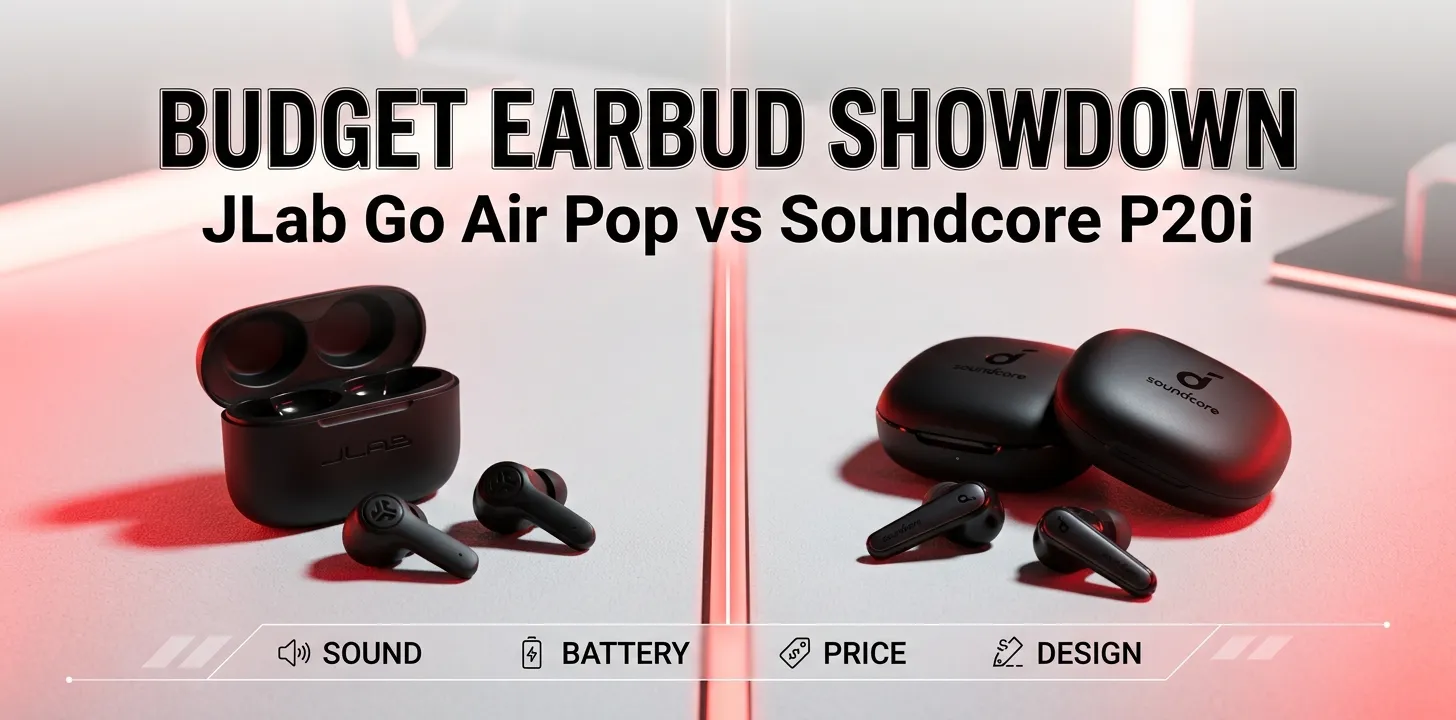
JLab Go Air Pop or Soundcore P20i for budget earbuds?

The JLab Go Air Pop and Soundcore P20i are both true wireless earbuds priced around $20, but they differ in fit, battery life, and app support. The Go Air Pop offers longer battery life and a lighter, stemless design, while the P20i has a stem shape, an app with EQ customization, and slightly better call quality. Your choice comes down to fit preference and whether you want app-based sound tuning.
Both earbuds show up constantly in “best budget earbuds under $25” roundups, and it’s easy to see why. They’re priced low enough that neither purchase feels risky, yet both deliver enough performance to actually replace a pair of wired earbuds or an aging older set. But “budget” doesn’t mean “identical,” and the differences between these two matter depending on how you plan to use them.
What Each Pair Actually Offers
Before getting into the comparison, it helps to know what you’re getting with each model.
The JLab Go Air Pop is a stemless, AirPods-style earbud that leans on simplicity. It’s tiny, light, and comes in a charging case about the size of a car key fob. JLab doesn’t include an app for these — what you get out of the box is what you get, aside from switching between three built-in EQ modes by tapping the earbud.
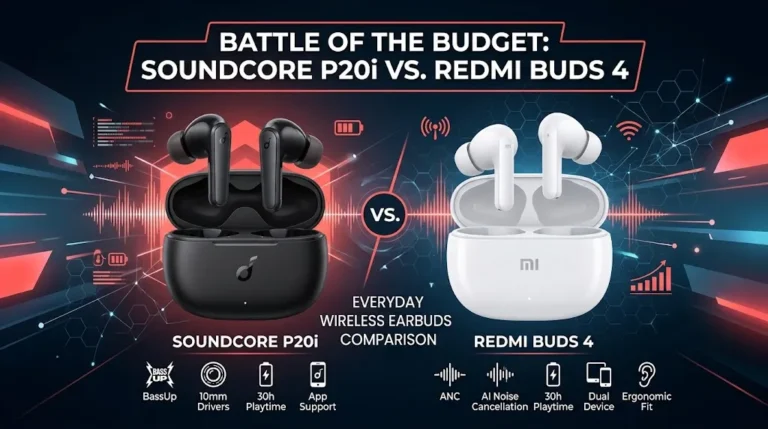
The Soundcore P20i, from Anker, uses a stem design closer to a shortened AirPods Pro shape. It pairs with the Soundcore app, which is one of its bigger selling points at this price. Through the app you can pick from 22 EQ presets, remap touch controls, and get firmware updates.
JLab Go Air Pop vs. Soundcore P20i: Key Specs Compared
| Feature | JLab Go Air Pop | Soundcore P20i |
|---|---|---|
| Price | Around $20 | Around $20 |
| Design | Stemless, AirPods-style | Stemmed, AirPods Pro-style |
| Weight (per earbud) | 3.7g | Slightly heavier, stem design |
| Driver size | 6mm | 10mm |
| Battery life (earbuds) | 8 hours | 8–10 hours (varies by test) |
| Total battery with case | 32 hours | 30 hours |
| Quick charge | 10 min = 1 hour | 10 min = 2 hours |
| IP rating | IPX4 | Water-resistant (IPX4/IPX5 depending on version) |
| Bluetooth version | 5.1 | 5.3 |
| App support | None | Soundcore app, 22 EQ presets |
| Charging case cable | Built-in USB cable | Separate USB-C cable |
| Warranty | 2 years | Standard 1-year (varies by retailer) |
Independent lab testing from TechGearLab measured the P20i’s real-world battery life at 8.5 hours, close to Anker’s claimed rating but not quite matching JLab’s tested 8-hour mark with a larger total case capacity.
Battery Life and Charging
Battery life is close enough that it shouldn’t be a deciding factor on its own. The Go Air Pop is rated for 8 hours per charge with 32 hours total from the case, while the P20i claims up to 10 hours per charge with 30 hours total, though independent testing put the P20i closer to 8.5 hours in real use.
Where the two really differ is charging speed. The P20i’s 10-minute quick charge gets you 2 hours of playtime, while the Go Air Pop’s same 10-minute charge only gets you 1 hour. If you tend to forget to charge your earbuds overnight and rely on quick top-ups before heading out, that difference adds up.
The charging cables themselves are also worth noting. JLab builds the USB cable directly into the case, so you can’t lose it, but you also can’t replace it if it wears out. The P20i uses a separate USB-C cable, which is more standard and easier to replace, but it’s one more thing to keep track of.
Fit, Comfort, and Design
This is where personal preference matters more than specs. The Go Air Pop is stemless and extremely light at 3.7 grams per earbud, sitting flush in the ear. Some people find this style more comfortable for smaller ear canals, though others report the seal loosening after a couple of hours of wear.
The P20i’s stem design pushes the microphone closer to your mouth, which tends to help with call clarity, and the stem shape gives you something to grip when inserting or removing the earbuds. If you’ve used AirPods or AirPods Pro before, the P20i’s shape will feel more familiar.
Neither earbud is built for intense workouts or rain exposure. Both carry an IPX4-equivalent rating, meaning they can handle sweat and light splashes but shouldn’t be submerged or worn in heavy rain.
Sound Quality
Neither of these earbuds is going for audiophile territory, and reviewers are consistent on that point. The Go Air Pop has a 6mm driver and leans toward a balanced sound with usable bass, though treble can distort at higher volumes in busier tracks. The P20i has a larger 10mm driver and pushes harder on bass, which works well for hip-hop, pop, and EDM but can sound muddy on more detail-oriented genres like acoustic or classical.
If podcasts or audiobooks are your main use case, both earbuds handle spoken word content fine, and the difference in driver size won’t matter much. If you listen to bass-heavy music and want more punch out of the box, the P20i’s bigger driver has an edge. If you’d rather tune the sound yourself, the P20i’s app-based EQ gives you more control than JLab’s three fixed presets.
Call Quality and Microphone Performance
This is one area where the two aren’t close. Reviewers consistently note that the Go Air Pop’s microphone struggles in windy or noisy environments, making it a weaker choice if you take a lot of calls outdoors or in traffic. The P20i uses two microphones with AI-assisted noise reduction for calls, and while it’s not flawless, background noise suppression tends to hold up better.
If you mainly use earbuds for music and the occasional call from a quiet room, this won’t be a dealbreaker either way. If calls are a regular part of your day, especially outside, the P20i is the safer pick.
App Support and Customization
The Soundcore app is a real advantage for the P20i. Beyond the 22 EQ presets, you can remap the touch controls to your preference, check firmware updates, and use a “Find My Earbuds” feature that makes a lost earbud chirp so you can locate it.
The Go Air Pop skips the app entirely. You get three EQ modes cycled by tapping the earbud: podcast, bass, and JLab Signature. That’s fine if you don’t care about tweaking settings, but it means less flexibility if your sound preferences change over time or you lose an earbud with no way to locate it remotely.
Which One Should You Buy?
Choose the JLab Go Air Pop if:
- You want the smallest, lightest earbud possible
- You prefer a stemless, flush-fit style
- Longer total playtime from the case matters more than fast top-ups
- You don’t care about app customization and want simple, fixed EQ modes
- You value a longer warranty period
Choose the Soundcore P20i if:
- You want app-based EQ customization and control remapping
- Call quality matters because you take calls in noisy or outdoor settings
- You prefer a stem design similar to AirPods Pro
- Fast charging (2 hours of playtime from a 10-minute charge) fits your routine
- You want a “Find My Earbuds” feature for peace of mind
For a real-world example: someone who commutes by bike and takes calls hands-free while riding will likely get more value from the P20i’s better call handling and stem-based mic placement. Someone who just wants tiny, forgettable earbuds for gym sessions and podcasts, without fussing over an app, will probably prefer the Go Air Pop’s lighter fit and longer total battery life.
Either way, you’re not making an expensive mistake. Both earbuds sit at the same rough price point, and both are widely considered solid entry points into wireless earbuds without the AirPods price tag.
Frequently Asked Questions
Are the JLab Go Air Pop and Soundcore P20i good for working out?
Both have IPX4-level water resistance, which handles sweat and light splashes but not heavy rain or submersion. Neither is marketed as a dedicated workout earbud, so if you need a secure fit for running, look at models with an ear hook or higher IP rating.
Does either earbud have active noise cancellation?
No. Both the Go Air Pop and P20i rely on passive noise isolation from the ear tip seal rather than active noise cancellation. If ANC is a priority, you’ll need to look at higher-priced models from either brand.
Can I use one earbud at a time with either model?
Yes, both support single-earbud mono use, which is useful for phone calls or if you only want one ear free to stay aware of your surroundings.
Bottom Line
The JLab Go Air Pop and Soundcore P20i both deliver solid performance for around $20, but they suit slightly different needs. If simplicity, lighter weight, and longer total battery life matter most, go with the Go Air Pop. If you want app customization and better call quality, the P20i is the stronger pick. Before buying either, check current retailer listings, since pricing and bundled colors shift often at this budget tier.