
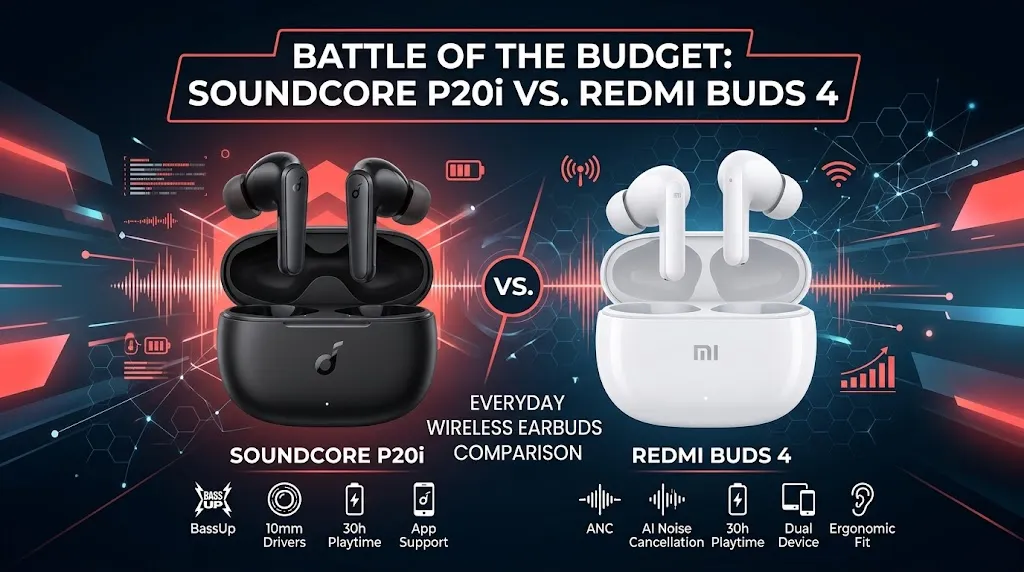
Soundcore P20i vs Redmi Buds 4: Which One Fits Your Daily Routine?

If you’re weighing the Soundcore P20i against the Redmi Buds 4, the short answer is this: the P20i is a no-frills, budget pick built for basic listening and calls, while the Redmi Buds 4 costs more but adds active noise cancellation and a more refined feature set. For most everyday use — commuting, working, walking, casual music — the right pick comes down to whether you need noise cancellation and are willing to pay roughly double for it.
What Each Pair Is Actually Built For
These two earbuds aren’t really direct competitors in the traditional sense. They’re aimed at different budgets within the same “cheap wireless earbuds” category.
The Soundcore P20i sits at the very low end of Anker’s Soundcore lineup, typically priced around $20 to $25. It skips features like ANC entirely and focuses on battery life, bass-heavy sound, and app customization at a rock-bottom price.
The Redmi Buds 4, from Xiaomi, usually runs closer to $40 on Amazon.com and adds hybrid active noise cancellation, a more premium two-driver-style tuning approach, and water resistance rated for sweat and light rain. It’s aimed at people who want ANC without paying $100-plus for it.
Soundcore P20i vs Redmi Buds 4: Quick Comparison
| Feature | Soundcore P20i | Redmi Buds 4 |
|---|---|---|
| Typical price | ~$20–$25 | ~$40 |
| Bluetooth version | 5.3 | 5.3 |
| Driver size | 10mm dynamic | 10mm dynamic |
| Active noise cancellation | None | Yes, up to 35dB, adaptive |
| Water resistance | IPX5 | IP54 |
| Battery (earbuds only) | Up to 10 hours | Shorter with ANC on; varies by mode |
| Battery (with case) | Up to 30 hours | Up to 30 hours (ANC off) |
| Fast charging | 10 min = 2 hours | Supported |
| Companion app | Soundcore app, 22 EQ presets | Xiaomi Earbuds app |
| Mic setup | 2 mics, AI call noise reduction | Dual mic with ENx voice algorithm |
| Weight (per earbud) | 4.4g | 4.5g |
| US retail availability | Widely available (Amazon, Best Buy, Micro Center) | Amazon only, limited US retail presence |
Sound Quality and Everyday Listening
Both earbuds use a 10mm dynamic driver, but they’re tuned differently.
The P20i’s sound quality works better for audiobooks and podcasts than for layered music with a broad soundstage. Vocal textures and breathiness are softened, reducing clarity and articulation, and the treble is safe and non-fatiguing but noticeably rolled off, with a soundstage that’s intimate and centered but lacks width and depth. In plain terms: it’s fine for background music, talk content, and casual listening, but it won’t impress anyone comparing detail or separation.
Anker leans into bass with a dedicated boost mode. The P20i uses BassUp technology to add extra punch for genres like EDM and hip-hop, and pairs that with 22 preset EQs in the Soundcore app so you can adjust the sound to your taste. That EQ access is a real advantage — you can dial back the bass emphasis if the default tuning feels muddy.
The Redmi Buds 4 doesn’t have the same volume of English-language reviews as its Pro sibling, but Xiaomi’s tuning across the Buds 4 line generally favors a warmer, more balanced sound than ultra-budget competitors, helped by the hybrid ANC actually removing some of the ambient noise that would otherwise mask detail.
Practical takeaway: if you mostly listen to podcasts, audiobooks, or background music at a desk, either works. If music clarity matters more to you, the ability to tweak EQ on the P20i partly closes the gap, but ANC on the Redmi Buds 4 does more to improve perceived clarity in noisy environments like buses or open offices.
Noise Cancellation: The Biggest Difference
This is the feature that actually separates these two products.
The Soundcore P20i has no active noise cancellation. It relies purely on the physical seal of the ear tips, which techgearlab’s testing found offered better-than-average passive noise cancellation for the price, but that’s still a fraction of what active cancellation delivers.
The Redmi Buds 4 uses hybrid active noise cancellation, where feed-forward and feedback microphones work together to separate background noise, offering up to 35dB of noise cancellation with one touch. It also intelligently switches between three ANC levels based on ambient noise through an adaptive mode, and includes a transparency mode for when you need to hear your surroundings.
If your daily routine includes a subway commute, an open-plan office, or flights, ANC changes the experience noticeably — it’s not just marketing. If you mostly use earbuds at home, on a quiet walk, or during workouts, passive isolation on the P20i is probably enough.
Battery Life and Charging
Battery life is one area where the cheaper P20i actually holds its own or edges ahead, depending on how you use ANC.
The P20i delivered approximately 8 hours and 20 minutes of playback in real-world testing at 70% volume, with the charging case providing an additional 27 hours, and a fast-charging feature that gives 2 hours of playtime from a 10-minute charge. That’s strong for a $20 product.
Xiaomi rates the Redmi Buds 4 at up to 30 hours total with the case when ANC is off, but like most ANC earbuds, running noise cancellation continuously will pull that number down. If all-day battery without recharging matters more than noise cancellation, factor that trade-off in.
Both use USB-C, so charging cable clutter isn’t a concern either way.
Calls, Comfort, and Water Resistance
Neither earbud is a standout for calls. The P20i’s call quality is described as subpar, and voice output loses volume and feels fragile in wind or breeze, despite decent background noise suppression. The Redmi Buds 4 uses a similar dual-mic noise reduction approach aimed at isolating speech, but it hasn’t been widely stress-tested in independent US reviews the way flagship earbuds have — treat call performance as a secondary consideration for either pair rather than a deciding factor.
For fit, the P20i uses a short-stem, in-ear design and weighs 4.4 grams per earbud, staying secure during walking and light jogging, though smaller ear canals may feel discomfort during longer sessions. The Redmi Buds 4 weighs a comparable 4.5 grams and uses a similar in-ear, stemmed shape.
On durability, the P20i carries an IPX5 rating, meaning it can handle water sprayed from a nozzle against the enclosure without harmful effects — good for sweat and rain, not for submersion. The Redmi Buds 4 carries IP54, which adds a dust-resistance rating on top of similar splash protection, useful if you’re using them at the gym or outdoors where dust and grit are a factor, not just moisture.
A Practical Example: Two Common Buyers
A commuter who rides the subway daily will likely get more real value out of the Redmi Buds 4. The ANC actively cuts train noise and chatter, which matters more on a loud platform than an extra few hours of battery.
Someone who mostly wears earbuds around the house, during errands, or on quiet walks may find the P20i is genuinely enough. You’re paying half the price for similar driver hardware, solid battery life, and an app that lets you shape the sound yourself — without paying for ANC you won’t use much.
Availability in the US
This matters more than it might seem. The Soundcore P20i is sold directly through Amazon, and it’s also stocked by retailers like Micro Center, giving you standard US warranty support and easy returns.
The Redmi Buds 4 base model is available on Amazon.com, but Xiaomi’s earbuds lineup doesn’t have the same broad US retail footprint as Anker’s Soundcore brand — you won’t typically find it at Best Buy or similar chains, and official Xiaomi US support is more limited than what Anker offers domestically. If having a straightforward return or warranty process matters to you, that’s worth weighing alongside the feature differences.
Frequently Asked Questions
Is the Soundcore P20i good enough for daily commuting?
It can work for commuting, but without active noise cancellation, you’ll hear more ambient train, bus, or street noise than with ANC earbuds. It’s better suited to quieter daily routines like home use, walking, or light exercise.
Does the Redmi Buds 4 work with iPhones as well as Android?
Yes, both earbuds pair over standard Bluetooth and work with iOS devices, though certain app-based features and quick-pairing conveniences are typically more polished on Android given both brands’ Android-first companion apps.
Which pair has better battery life for all-day use?
The Soundcore P20i has slightly better tested single-charge battery life since it has no ANC drawing extra power, while the Redmi Buds 4’s 30-hour case total assumes ANC is off; running noise cancellation regularly will shorten that.
The Bottom Line
For everyday use, the choice mostly comes down to noise. If you need to cancel out background noise on a regular basis, the Redmi Buds 4’s adaptive ANC justifies the extra cost. If your daily use is lower-key — home, errands, workouts, quiet commutes — the Soundcore P20i delivers solid battery life, a real EQ customization option, and broader US retail support for about half the price. Before buying either, check current listings for IP rating and included accessories, since budget earbud specs occasionally shift between production runs.