Amazfit Active 2 or Redmi Watch 5 for sleep tracking?

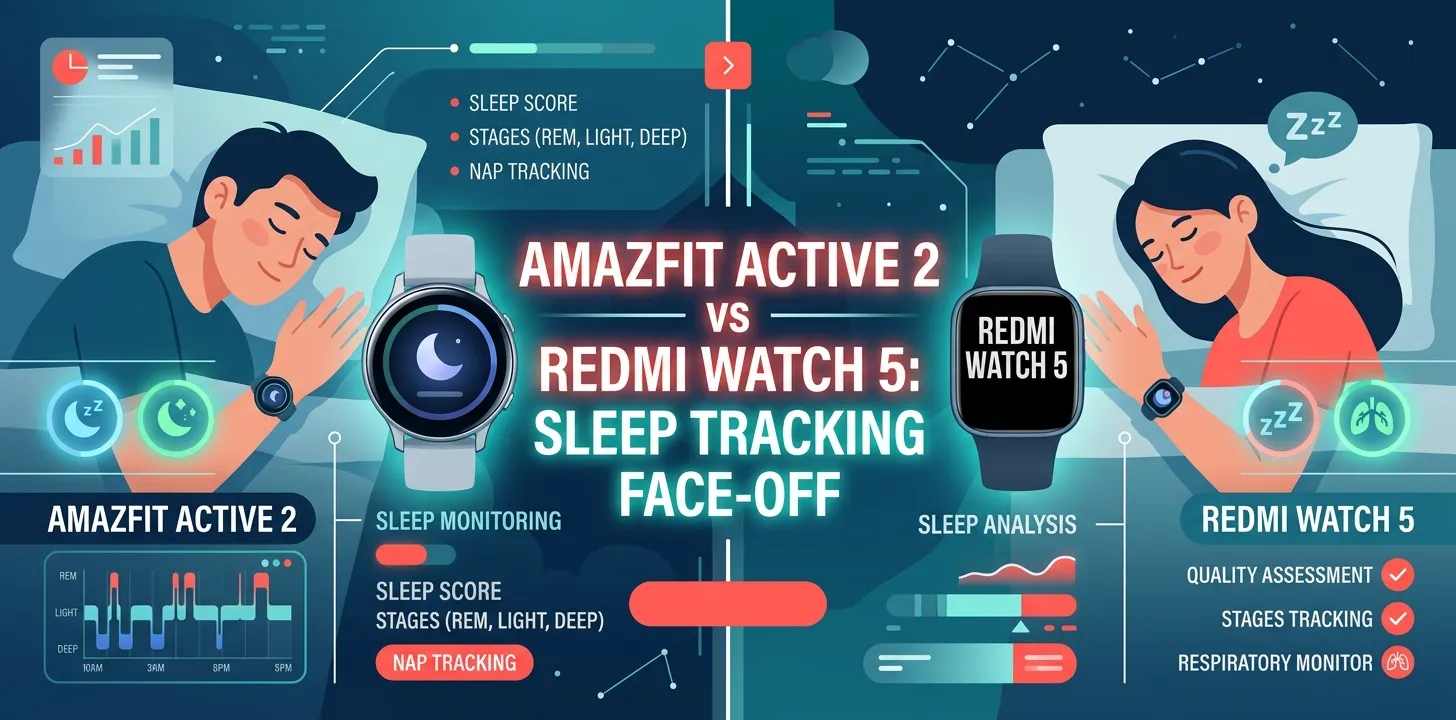
If sleep tracking is your main reason for buying a smartwatch, the Amazfit Active 2 is the stronger choice overall. It offers sleep duration, sleep stages, sleep scores, naps, breathing-quality monitoring, and assisted sleep monitoring through the Zepp app. The Redmi Watch 5 also tracks sleep, including naps, deep, light, and REM sleep, but its sleep detection relies more heavily on movement unless advanced monitoring is enabled.
For most people who care about sleep detail and recovery insights, I would pick the Active 2. The Redmi Watch 5 makes more sense if you want a larger screen, very long battery life, and basic sleep tracking without paying for a more sleep-focused feature set.
Amazfit Active 2 vs. Redmi Watch 5 for Sleep Tracking
Both watches can track sleep automatically when worn overnight. They can estimate when you fall asleep and wake up and provide information about sleep stages.
The difference is in how much sleep-related information you get and how the apps present it.
| Sleep feature | Amazfit Active 2 | Redmi Watch 5 |
|---|---|---|
| Automatic sleep tracking | Yes | Yes |
| Sleep duration | Yes | Yes |
| Sleep stages | Yes | Yes |
| REM sleep | Yes | Yes |
| Deep/light sleep | Yes | Yes |
| Naps | Yes | Yes |
| Sleep score | Yes | Yes |
| Sleep breathing information | Yes | Yes, with advanced monitoring |
| Assisted/advanced sleep monitoring | Yes | Yes |
| Sleep app | Zepp | Mi Fitness |
| Sleep HRV | Yes | Not a main sleep feature |
| Recovery/readiness information | Yes | More limited |
| Battery life advantage | Good | Stronger |
Amazfit specifically says the Active 2’s sleep system tracks sleep quality, breathing, stages, and naps. Its Zepp app also provides sleep-related health information.
Xiaomi says the Redmi Watch 5 can show sleep duration, deep sleep, light sleep, REM sleep, wake-ups, and detailed sleep periods in the Mi Fitness app.
Why the Amazfit Active 2 Is Better for Sleep
The biggest advantage of the Active 2 is that sleep tracking is part of a broader recovery system rather than just a nightly duration measurement.
Amazfit’s current product information says the Active 2 tracks:
- Sleep quality
- Sleep stages
- Sleep breathing
- Naps
- Sleep HRV
- Daily readiness/recovery information
The watch also supports Assisted Sleep Monitoring, which can collect additional sleep information such as REM sleep, along with sleep breathing-quality monitoring.
That makes it more useful if your goal is to look beyond “I slept 7 hours” and understand your nightly patterns over time.
An independent Wareable review also found the Active 2’s core sleep measurements generally good, with sleep-stage results that were reasonably close to an Oura Ring in its testing. However, the reviewer noted that the watch sometimes recorded longer sleep than expected on certain nights.
So the Active 2 is not a medical-grade sleep device. It is better viewed as a consumer wellness tracker that can help you spot patterns.
How Good Is the Redmi Watch 5 at Sleep Tracking?
The Redmi Watch 5 is not a bad sleep tracker. In fact, it covers the main information most people want.
Xiaomi says it can monitor overnight sleep as well as sporadic naps. With advanced monitoring enabled, it can provide sleep-stage information including deep, light, and REM sleep, along with wake periods.
The Mi Fitness app also keeps historical sleep information so you can look at your patterns over longer periods.
The important catch is that Xiaomi explains that the basic sleep algorithm uses accelerometer movement data to determine whether you’re asleep or awake. With Advanced Monitoring and Breathing Rate enabled, PPG data is also used to analyze sleep stages.
That distinction matters.
For example, if you’re lying very still in bed while watching a movie or using your phone, the watch may interpret the low movement as sleep. Xiaomi openly documents this limitation.
An independent Wareable review found the Redmi Watch 5’s sleep timing and sleep-stage tracking reasonably close to an Oura Ring during testing, although its sleep scores tended to be more positive.
Which Has More Useful Sleep Data?
For a person who wants more than basic sleep duration, the Amazfit Active 2 has the edge.
Its sleep system connects sleep information with other recovery-related measurements. For example, the watch can track sleep HRV and provide a daily readiness score.
The Redmi Watch 5 gives you the essential sleep information in Mi Fitness, including:
- Total sleep time
- Sleep periods
- Deep sleep
- Light sleep
- REM sleep
- Wake-ups
- Sleep quality information
That’s enough for many casual users.
The difference is that Amazfit puts more emphasis on sleep analysis and recovery, while Redmi focuses on giving you useful sleep tracking as part of a broader budget smartwatch.
Which Is More Accurate for Sleep?
There is no reliable reason to treat either watch as perfectly accurate.
Consumer smartwatches estimate sleep using sensors and algorithms. They are not directly measuring brain activity in the same way a clinical sleep study does.
The available independent testing gives both watches some credit for useful sleep tracking. Wareable found the Active 2 generally close to its comparison tracker for core sleep data, while its Redmi Watch 5 review also found sleep timing and stages roughly similar to an Oura Ring.
The more important question is what you want the data for.
If you want to notice patterns such as:
- “I sleep less on school or work nights.”
- “My sleep time changes when I exercise late.”
- “I’m waking up more often than usual.”
either watch can be useful.
If you’re looking for a device to diagnose a sleep disorder or make medical decisions, neither should be treated as a substitute for professional evaluation.
A Key Difference: Sleep Breathing and Advanced Monitoring
This is one area where the Active 2 becomes more interesting for sleep-focused buyers.
Amazfit provides a dedicated sleep breathing-quality monitoring feature. Its support documentation says the watch can automatically monitor breathing quality when it detects that you’re wearing it during sleep.
The Redmi Watch 5 also has advanced sleep monitoring. Xiaomi says that enabling Advanced Monitoring and Breathing Rate allows the watch to use PPG alongside movement data to produce sleep-stage results.
Neither feature should be interpreted as a medical diagnosis.
The practical takeaway is simple: both watches can provide more than basic sleep duration, but the Active 2 offers a more developed sleep-and-recovery experience.
Battery Life Matters More Than It Seems for Sleep Tracking
A smartwatch cannot track your sleep if you’re charging it overnight.
This is where the Redmi Watch 5 has a major advantage. Its large battery is rated for substantially longer use than the Active 2 in many comparison listings.
The Active 2 is still practical for overnight tracking, but you have less flexibility if you want to leave it on continuously and use many health-monitoring features.
For example, someone who regularly forgets to charge a watch may actually get more consistent real-world sleep data from the Redmi Watch 5, simply because its longer battery life makes overnight wear easier.
That’s an important trade-off that a feature checklist can miss.
Which Sleep Tracker Is Better for Different Users?
Choose Amazfit Active 2 if you want deeper sleep insights
The Active 2 is the better fit if you care about:
- Sleep stages
- Sleep scores
- Naps
- Breathing-quality monitoring
- Sleep HRV
- Recovery and readiness
- More detailed sleep analysis
- A stronger sleep-focused companion app
Its Zepp ecosystem gives sleep tracking a bigger role in the overall health experience.
Choose Redmi Watch 5 if you want simple tracking and long battery life
The Redmi Watch 5 is a better fit if you mainly want:
- Sleep duration
- Sleep stages
- Nap tracking
- Basic sleep-quality information
- A large display
- Long battery life
- A straightforward smartwatch experience
Its Mi Fitness app provides daily and longer-term sleep information, while the watch itself can show recent sleep data.
For someone who forgets to charge their watch
I’d lean toward the Redmi Watch 5.
Longer battery life can make a real difference because sleep tracking depends on actually wearing the watch every night.
For someone who wants to improve sleep habits
I’d lean toward the Amazfit Active 2.
Its sleep scoring, sleep-stage information, breathing monitoring, HRV, and readiness features give you more data to work with.
Two Real-World Examples
Imagine you want a smartwatch mainly to answer one question: “How long did I sleep last night?”
The Redmi Watch 5 is plenty capable. It can automatically recognize sleep and show your sleep duration and stages in Mi Fitness.
Now imagine you want to compare your sleep over several weeks and pay attention to sleep stages, breathing, HRV, and your daily recovery.
In that case, the Amazfit Active 2 makes more sense because its sleep tracking is tied more closely to its broader recovery features.
How to Get Better Sleep Data From Either Watch
The quality of your data depends partly on how you wear the watch.
Wear it snugly enough that the sensors maintain contact with your skin, but not so tightly that it becomes uncomfortable.
For the Redmi Watch 5, Xiaomi specifically says loose wearing can cause the watch to lose contact with the wrist and fail to record sleep correctly. It also says very short sleep periods may not be detected.
It’s also worth syncing the watch with its phone app regularly. Xiaomi warns that detailed sleep data stored on the Watch 5 itself has limited retention before synchronization becomes important.
For the Active 2, make sure Assisted Sleep Monitoring and sleep breathing monitoring are enabled if you want the additional sleep information those features provide.
Amazfit Active 2 or Redmi Watch 5: Which Should You Buy for Sleep Tracking?
For sleep tracking specifically, I would choose the Amazfit Active 2.
It offers the more complete sleep package, with sleep stages, sleep scores, naps, breathing-quality monitoring, sleep HRV, and recovery-oriented features.
The Redmi Watch 5 is the better alternative if battery life is your top priority. Its sleep tracking covers the basics well, and independent testing found its sleep timing and stages reasonably close to a higher-end comparison tracker.
So the decision is less about whether one watch can track sleep and more about how much you want from that tracking:
| Your priority | Better choice |
|---|---|
| Overall sleep tracking | Amazfit Active 2 |
| More sleep and recovery data | Amazfit Active 2 |
| Sleep HRV | Amazfit Active 2 |
| Breathing-quality monitoring | Amazfit Active 2 |
| Basic sleep tracking | Redmi Watch 5 |
| Very long battery life | Redmi Watch 5 |
| Simple overnight tracking | Redmi Watch 5 |
| Best choice for sleep-focused users | Amazfit Active 2 |
Frequently Asked Questions
Is the Amazfit Active 2 more accurate than the Redmi Watch 5 for sleep?
Both can provide useful estimates of sleep duration and stages, but neither should be considered perfectly accurate. Independent testing has found both watches reasonably comparable with higher-end consumer sleep trackers in some areas, while also showing limitations in sleep scoring and sleep-duration estimates.
Does the Redmi Watch 5 track REM and deep sleep?
Yes. With the appropriate advanced monitoring enabled, the Redmi Watch 5 can report deep sleep, light sleep, REM sleep, and wake periods through the Mi Fitness app.
Is the Amazfit Active 2 worth choosing just for sleep tracking?
Yes, if you want detailed sleep and recovery information rather than only basic sleep duration. Its sleep features include stages, sleep score, naps, breathing-quality monitoring, and sleep HRV, making it the stronger option for someone who plans to pay close attention to sleep trends.
Final Verdict
If sleep tracking is the deciding factor, get the Amazfit Active 2. It gives you a richer set of sleep and recovery metrics and is better suited to someone who wants to study sleep patterns over time.
Choose the Redmi Watch 5 instead if you want reliable basic sleep tracking combined with a larger display and much longer battery life.
One practical tip: whichever watch you choose, focus on trends over many nights rather than a single night’s score. Sleep algorithms can make mistakes, so one unusual result does not necessarily mean anything is wrong.