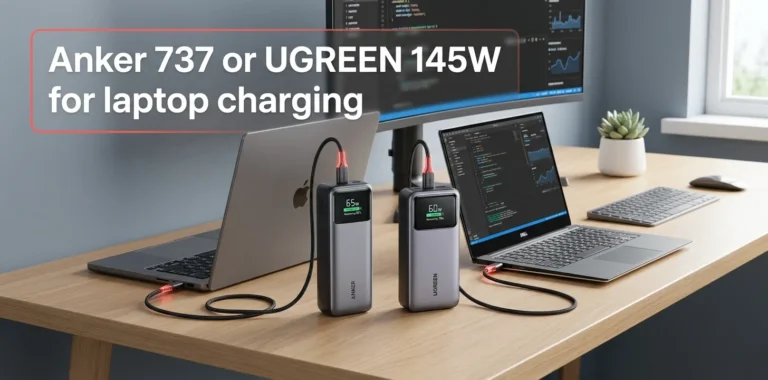
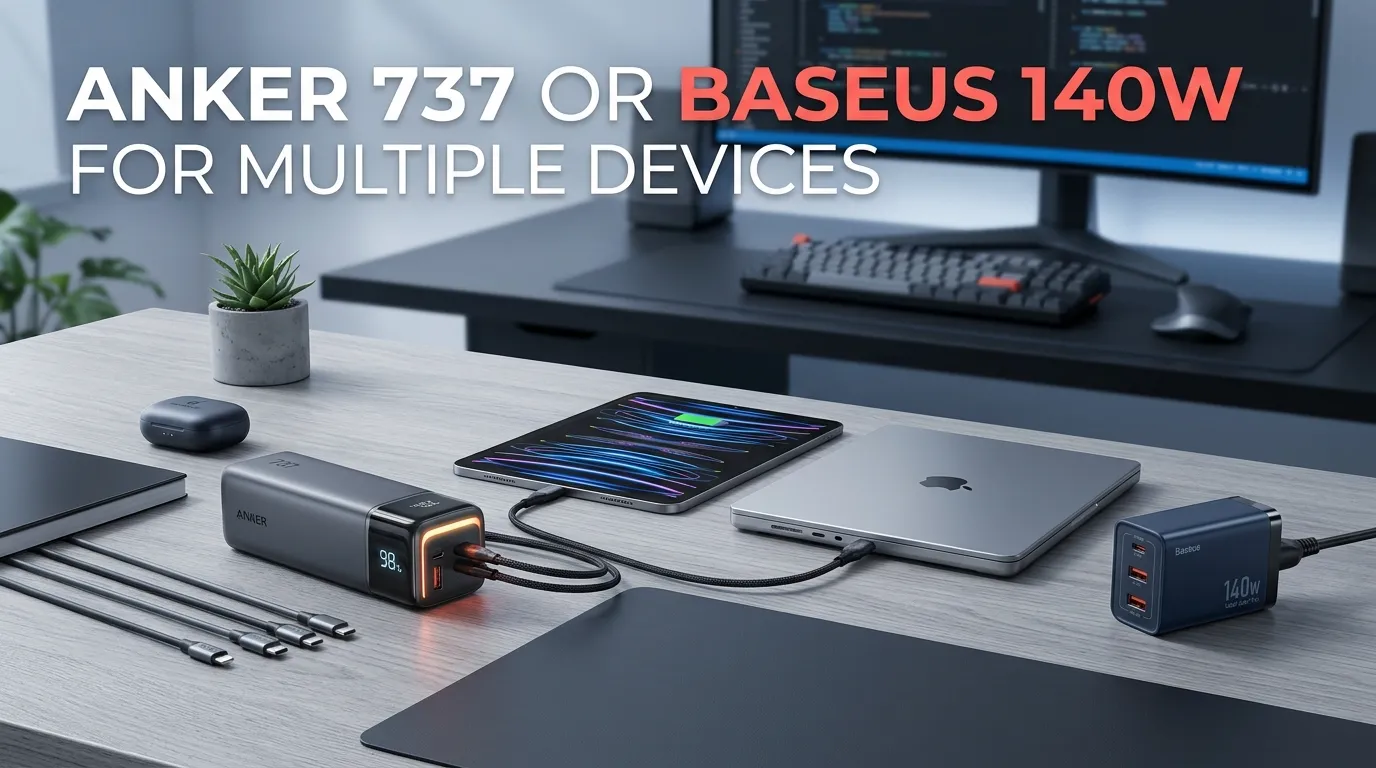
Anker 737 or Baseus 140W for multiple devices?

If you need one power bank to charge a laptop, phone, tablet, and accessories, both the Anker 737 and Baseus Adaman 140W are strong choices. Both offer 140W-class USB-C output and three charging ports, but the Anker 737 has a more informative display and a well-documented 24,000mAh capacity, while the Baseus is lighter and offers similar multi-device flexibility.
For most people charging several devices, the Anker 737 is the better overall pick if you value capacity, monitoring, and predictable high-power USB-C charging. The Baseus Adaman 140W is more appealing if lower weight and a slimmer design matter more.
The two power banks at a glance
| Feature | Anker 737 | Baseus Adaman 140W |
|---|---|---|
| Listed capacity | 24,000mAh | 24,000mAh |
| Energy | About 86Wh | About 86.4Wh |
| Maximum output | 140W | 140W |
| USB-C ports | 2 | 2 |
| USB-A ports | 1 | 1 |
| Devices at once | 3 | 3 |
| Digital display | Yes | Yes |
| Weight | About 22 oz | About 16.7 oz |
| Laptop charging | Yes | Yes |
| Best advantage | Monitoring and high-power USB-C | Lower weight |
The Anker 737’s official specifications list two USB-C ports, one USB-A port, 24,000mAh capacity, and 140W maximum total output. Baseus lists the Adaman 140W as a three-port power bank with two USB-C ports and one USB-A port.
Which is better for charging multiple devices?
The Anker 737 gets the edge for a mixed-device setup, especially if one of those devices is a high-power laptop.
Its two USB-C ports can each support the power bank’s high-output USB-C charging system, while the USB-A port handles older accessories. The important point is that the 140W figure is the total maximum output, not 140W simultaneously from every port.
That distinction matters when you connect several devices.
For example, a setup could include:
- A USB-C laptop
- An iPhone or Android phone
- Wireless earbuds or another USB-A accessory
The power bank distributes available power based on what the connected devices request. You should not expect a 140W laptop connection plus another 140W connection at the same time.
The Baseus follows the same basic idea. Its specifications show multiple-device charging, but the available power changes when several ports are being used.
Anker 737: better for power-hungry laptops
The Anker 737 makes the most sense when your main concern is keeping a demanding laptop running away from an outlet.
It supports up to 140W output through USB-C, including the PD 3.1 power level needed by compatible high-power devices. Anker specifically notes that reaching 140W requires a compatible PD 3.1 device and cable.
That gives the 737 an advantage for users carrying devices such as:
- High-performance MacBook models
- USB-C Windows laptops
- Tablets
- Smartphones
- Portable gaming devices
However, the laptop itself controls how much power it accepts. A laptop designed for 65W or 100W charging will not suddenly draw 140W simply because the power bank can provide it.
The display is genuinely useful
The 737 has a digital display that can show charging information such as power input and output, battery information, and other operating data.
That’s particularly helpful when several devices are connected.
Instead of guessing why your laptop is charging slowly, you can look at the power-bank display and see what is happening.
Baseus Adaman 140W: better when weight matters
The Baseus Adaman has a major practical advantage: it’s substantially lighter than the Anker 737.
Baseus lists the Adaman 140W at roughly 473g, while Anker’s published specifications put the 737 around 630g depending on the regional specification page.
That’s a meaningful difference if you carry a power bank every day.
A lighter power bank can be attractive for:
- Students
- Travelers
- Commuters
- Backpack users
- People who already carry a laptop charger
- Anyone who dislikes carrying a heavy battery brick
The Baseus also has two USB-C ports and one USB-A port, so it does not give up the basic three-device setup.
Which one handles three devices better?
For three-device charging, neither has a huge advantage based only on port count. Both provide two USB-C connections plus one USB-A connection.
The bigger question is what those three devices are.
Laptop + phone + earbuds
Both work well.
The laptop should get priority through USB-C, while the phone can use the second USB-C port and earbuds can use USB-A.
Laptop + tablet + phone
The Anker 737 is the one I’d choose if the laptop needs high power.
The Baseus can also handle this kind of setup, but you need to pay attention to how its available output is divided between ports. Its published specifications show reduced output when multiple ports are active.
Three low-power devices
This is where the difference becomes much smaller.
If you’re charging a phone, smartwatch, earbuds, or similar accessories, paying extra attention to 140W peak output is not very useful. Those devices generally won’t need anything close to 140W.
In that situation, the lighter Baseus can make more sense.
Capacity: Anker 737 vs Baseus 140W
Both are marketed around the 24,000mAh capacity class.
The Anker 737 is officially listed at 24,000mAh, and its battery energy is roughly 86Wh. Baseus also lists the Adaman 140W at 24,000mAh/86.4Wh on its current product information.
In real use, don’t expect the full printed battery capacity to become usable device power. Energy is lost during voltage conversion, heat production, and charging.
So the useful question isn’t simply “Which has more mAh?”
In this comparison, capacity is essentially a tie. Your choice should be based more on output behavior, weight, ports, monitoring, and how you plan to carry the power bank.
Which has the better port setup?
It’s basically a tie on flexibility.
Both provide:
- 2 × USB-C
- 1 × USB-A
That’s a useful combination for a modern travel bag because USB-C can handle laptops and newer phones, while USB-A remains useful for older cables and accessories.
The important detail is that three ports does not mean three high-power outputs.
When multiple devices are connected, available power is shared.
This is one of the easiest things to misunderstand when shopping for a 140W power bank.
Which one is better for travel?
For frequent travel, I’d lean toward the Baseus if weight is your biggest concern.
The Baseus is roughly 473g, while the Anker 737 is around 630g. That’s around 157g of difference before you even add cables.
The Anker is still a reasonable travel choice, especially if you need its higher-power USB-C capabilities and monitoring features. Its 24,000mAh battery is also below the commonly relevant 100Wh threshold for carry-on power banks, but airline rules can change and individual airlines may impose additional requirements, so travelers should check their airline’s current rules before flying.
Which is better for everyday use?
For everyday use, the decision is closer.
Choose the Anker 737 if:
- You regularly charge a laptop from the power bank.
- You want detailed charging information on the display.
- You want a well-documented 140W USB-C power system.
- Weight is not your biggest concern.
- You often carry several USB-C devices.
Choose the Baseus Adaman 140W if:
- You want a lighter high-output power bank.
- You regularly carry it in a backpack.
- You still need USB-A alongside USB-C.
- Your laptop doesn’t require the maximum available power.
- You want similar three-device charging flexibility without as much weight.
Two real-world setups
Scenario 1: MacBook + iPhone + AirPods
Imagine you’re working from a coffee shop and your MacBook battery is getting low. Your iPhone also needs charging, and your AirPods are nearly empty.
The Anker 737 is a strong fit because you can connect all three devices while giving the laptop access to its high-power USB-C output. The display also lets you monitor what’s happening.
The Baseus can handle the same basic three-device arrangement, making it attractive if you’re trying to keep your travel bag lighter.
Scenario 2: Phone + tablet + earbuds
If your laptop isn’t part of the equation, the 140W maximum becomes much less important.
A phone, tablet, and earbuds don’t necessarily need a 140W-class power bank. Both products can handle the setup, but the lighter Baseus becomes easier to justify because you’re carrying less weight without giving up the three-port arrangement.
One important detail about 140W charging
A 140W label does not automatically mean every device will charge at 140W.
Three things need to line up:
- The power bank must support the required charging standard.
- Your device must support the corresponding input power.
- Your cable must support the required power level.
Anker explicitly says a PD 3.1-compatible device and cable are required to reach 140W.
So if your laptop only accepts 65W, buying a 140W power bank mainly gives you extra headroom rather than making that laptop charge at 140W.
What about recharge speed?
Both are designed for relatively fast recharging, but the exact experience depends on the charger, cable, and charging protocol.
Anker documents up to 140W input for the 737 and says a suitable 140W PD charger can recharge it in about an hour under its stated conditions.
Baseus describes the Adaman 140W as supporting up to 100W rapid recharging.
So if you’re someone who frequently empties the power bank and needs to refill it quickly, the Anker has the stronger documented input specification.
The biggest trade-off between them
The choice becomes fairly simple when you ignore the marketing numbers.
| Your priority | Better choice |
|---|---|
| High-power laptop charging | Anker 737 |
| Charging three devices | Tie |
| USB-C flexibility | Tie |
| USB-A support | Tie |
| Battery capacity | Tie |
| Detailed monitoring | Anker 737 |
| Lower weight | Baseus Adaman 140W |
| Frequent travel with a lighter bag | Baseus Adaman 140W |
| Fast power-bank recharge | Anker 737 |
| Overall for demanding multi-device users | Anker 737 |
Which should you buy for multiple devices?
If the phrase “multiple devices” means a laptop plus a phone plus smaller accessories, I’d choose the Anker 737.
Its 24,000mAh capacity, 140W maximum output, two USB-C ports, USB-A port, and detailed display make it a particularly good fit for a mixed laptop-and-mobile setup.
If your main concern is carrying weight, the Baseus Adaman 140W becomes the better choice. Its roughly 473g body is considerably lighter than the Anker 737, while it keeps the same basic three-port layout and 140W-class headline output.
The biggest mistake would be choosing based only on the “140W” number. For multiple-device charging, how the power is shared between ports matters just as much as the maximum single-port output.
Frequently Asked Questions
Can the Anker 737 charge three devices at the same time?
Yes. The Anker 737 has two USB-C output ports and one USB-A output port, allowing three devices to be connected simultaneously. Its 140W rating is the maximum total output, so the available power is shared when multiple devices are charging.
Is the Baseus 140W power bank lighter than the Anker 737?
Yes. The Baseus Adaman 140W is listed at about 473g, while the Anker 737 is around 630g on Anker’s current specification page. That makes the Baseus noticeably easier to carry.
Is 140W enough to charge a laptop and phone together?
Yes, for compatible devices, but the power is divided between the connected devices. A laptop that can accept 100W, for example, may receive less when another device is drawing power at the same time, depending on the power bank’s output-sharing behavior.
The best choice comes down to your load. Pick the Anker 737 for demanding laptop-plus-device setups and better monitoring; pick the Baseus Adaman 140W when you want similar multi-device capability in a lighter package. Before buying, check your laptop’s USB-C input requirement and the power bank’s multi-port output limits rather than looking only at the 140W headline number.
Conclusion
For charging multiple devices, the Anker 737 is the better overall choice if you regularly power a laptop, phone, and other accessories. Its 140W output, 24,000mAh capacity, multiple ports, and detailed display make it a strong option for demanding users.
The Baseus 140W is the better pick if portability matters more. It offers similar multi-device flexibility while being noticeably lighter. Choose Anker for power and monitoring; choose Baseus for a lighter everyday carry.
Before buying, check your laptop’s USB-C power needs and how each power bank divides power across multiple ports.