
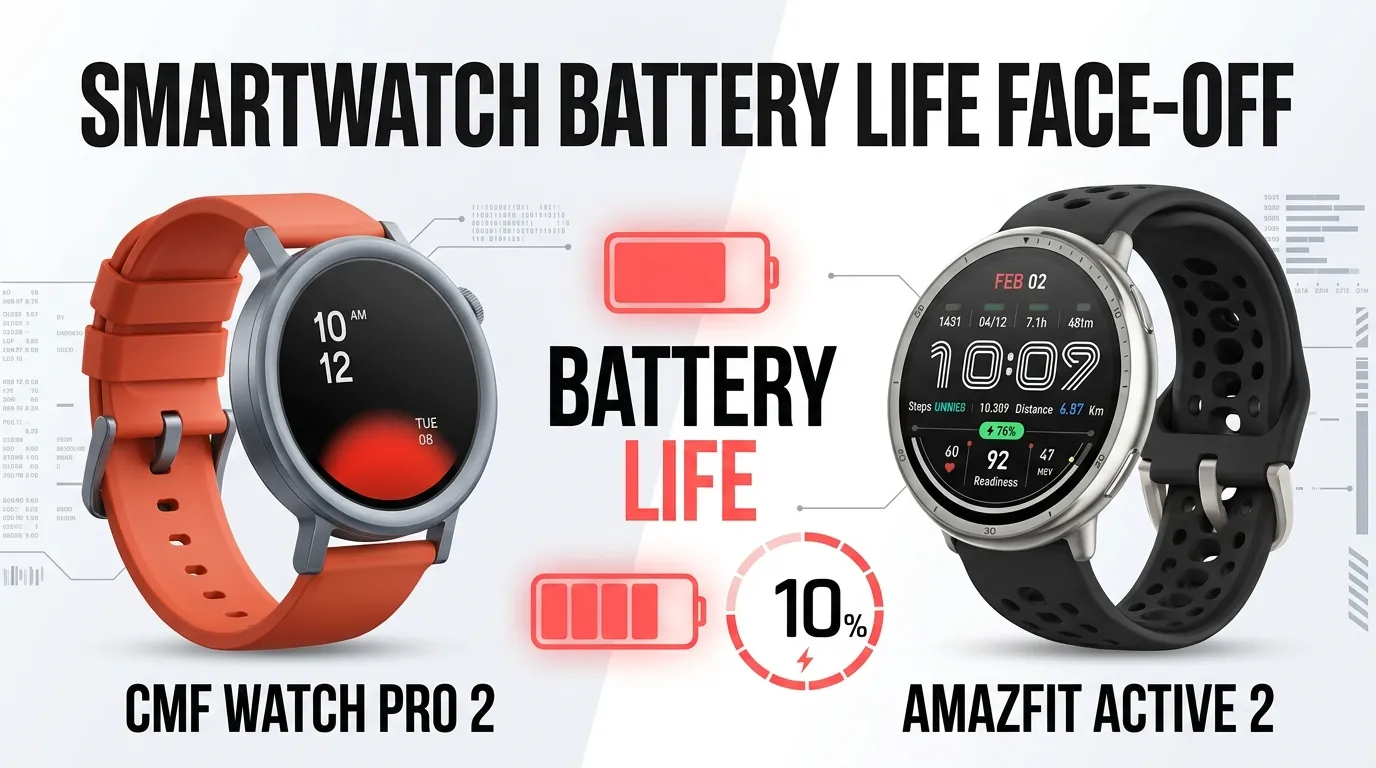
CMF Watch Pro 2 or Amazfit Active 2 for battery life?

If battery life is your main concern, the CMF Watch Pro 2 has a slight advantage on paper. CMF rates it for up to 11 days of typical use, compared with up to 10 days for the Amazfit Active 2. The difference is small, though, and the Active 2 offers up to 21 hours of continuous GPS use.
| Battery factor | CMF Watch Pro 2 | Amazfit Active 2 |
|---|---|---|
| Typical use | Up to 11 days | Up to 10 days |
| Heavy use | Up to 9 days | Up to 5 days |
| Battery saver | Up to 45.8 days | Up to 19 days |
| Continuous GPS | Up to 25 hours | Up to 21 hours |
| Continuous Bluetooth calls | Up to 17.4 hours | Not listed by Amazfit |
| Battery capacity | 305 mAh | 270 mAh |
| Full charge | About 100 minutes | About 2 hours |
The figures above come from the manufacturers’ published specifications, so actual battery life will depend on settings, screen use, GPS, health tracking, notifications, and other features.
CMF Watch Pro 2 vs. Amazfit Active 2: Which Lasts Longer?
For pure battery endurance, CMF Watch Pro 2 wins. Its rated typical battery life is 11 days, giving it a one-day lead over the Active 2’s 10-day rating.
That one-day difference is not enough to make the Active 2 a poor choice. In fact, both watches are designed to avoid the daily charging routine common with many full-featured smartwatches.
The bigger difference appears when you look at heavy use and power-saving modes.
CMF lists up to 9 days under its heavy-use test and up to 45.8 days in power-saving mode. Amazfit lists up to 5 days under heavy use and up to 19 days in battery-saver mode.
So if you want the longest possible time between charges, the CMF has the stronger battery specifications.
How Much Difference Does One Extra Day Make?
A one-day advantage sounds small, but it can be useful if you dislike charging your watch.
For example, suppose you normally charge a watch every Saturday morning. A watch rated for 11 days gives you slightly more flexibility if you forget to charge it or have a busy weekend.
But you should not expect exactly 11 days from either watch in every situation. Manufacturer battery ratings use specific test conditions. CMF’s 11-day test, for example, includes limited GPS use, defined notification levels, scheduled heart-rate measurements, and limited Bluetooth calling.
If you turn on more power-hungry features, battery life can fall much faster.
Always-on display can change the result
The display is one of the biggest factors to consider.
CMF reports up to 3.9 days with heavy usage and 12 hours of daily always-on display enabled.
That is a good reminder that an advertised “11-day battery” does not mean 11 days with every feature turned on.
If battery life matters more than having the screen constantly visible, leaving always-on display disabled can make more sense.
GPS Battery Life: CMF Has the Edge
If you regularly use GPS without your phone, CMF again has the higher published number.
CMF rates the Watch Pro 2 for up to 25 hours of continuous GPS use, while Amazfit rates the Active 2 for up to 21 hours.
That gives CMF a four-hour advantage in the manufacturers’ specifications.
This matters most for activities such as long hikes, extended outdoor walks, or long-distance training.
The difference is less important if you only use GPS for short runs or occasional outdoor workouts.
Which Is Better for Everyday Battery Life?
For normal smartwatch use, both should comfortably fit a multi-day charging routine.
CMF Watch Pro 2
The CMF is the better choice if your main goal is maximum battery endurance.
Its published numbers are strong across several categories:
- 11 days of typical use
- 9 days of heavy use
- 45.8 days in power-saving mode
- 25 hours of continuous GPS
- 17.4 hours of continuous Bluetooth calls
These figures are based on CMF’s stated test conditions and should be treated as estimates rather than guaranteed results.
Amazfit Active 2
The Active 2 is rated for:
- 10 days of typical use
- 5 days of heavy use
- 19 days in battery-saver mode
- 21 hours of continuous GPS
Amazfit also lists a roughly two-hour charging time.
Its battery performance is still strong for a smartwatch with features such as GPS, health tracking, workout tracking, and its AMOLED display.
What About Battery Life During Workouts?
This is where you should look beyond the headline “10 days” or “11 days.”
GPS tracking uses substantially more power than simply checking the time or receiving notifications.
The published continuous-GPS ratings are:
- CMF Watch Pro 2: up to 25 hours
- Amazfit Active 2: up to 21 hours
For someone who runs three or four times a week, both watches provide plenty of stated GPS endurance for normal workout sessions.
For someone doing very long outdoor activities, CMF’s higher GPS rating gives it more room before you need to recharge.
Which Watch Is Better for Frequent Charging?
If you hate charging devices, the CMF Watch Pro 2 is the better pick.
It has the higher typical-use rating, higher heavy-use rating, much longer power-saving rating, and higher continuous-GPS rating.
The Active 2 still performs well, but its main advantages are not simply about squeezing out the maximum number of days from the battery.
Amazfit packs the Active 2 with features such as 160+ workout modes, offline maps, turn-by-turn GPS directions, and Zepp Flow voice control.
If those features matter to you, a one-day difference in typical battery life may not be enough reason to choose CMF.
Two Real-World Buying Scenarios
Imagine you mainly want a watch for notifications, steps, sleep tracking, occasional workouts, and checking the time. You don’t use GPS very often and don’t keep the screen constantly on. CMF Watch Pro 2 makes more sense if minimizing charging is your top priority.
Now consider a runner who wants detailed training tools, offline maps, workout modes, and GPS navigation. The Amazfit Active 2 may be the better overall fit, even though its rated typical battery life is one day shorter. Its battery is still rated for up to 21 hours of continuous GPS use, while the watch offers a much broader fitness feature set.
CMF Watch Pro 2 or Amazfit Active 2: Which Should You Buy for Battery Life?
Choose the CMF Watch Pro 2 if battery life is the deciding factor.
It has a small advantage in typical use—11 days versus 10—and a larger advantage in the manufacturers’ heavy-use and power-saving figures. It also has the higher rated continuous GPS endurance.
Choose the Amazfit Active 2 if you’re willing to give up roughly one day of rated typical battery life for a stronger set of fitness and navigation features.
The practical difference is simple: CMF Watch Pro 2 wins for battery endurance, while Amazfit Active 2 can make more sense if fitness features matter more than squeezing out the last day of battery life.
Frequently Asked Questions
Does CMF Watch Pro 2 last longer than Amazfit Active 2?
Yes. CMF rates the Watch Pro 2 for up to 11 days of typical use, while Amazfit rates the Active 2 for up to 10 days. CMF also has higher published figures for heavy use, power-saving mode, and continuous GPS.
Which has better GPS battery life, CMF Watch Pro 2 or Amazfit Active 2?
The CMF Watch Pro 2 has the higher published GPS rating at up to 25 hours of continuous GPS use. Amazfit rates the Active 2 for up to 21 hours.
Is the one-day battery difference important?
Usually, no. Both watches offer multi-day battery life, so the bigger buying decision should be whether you value CMF’s stronger battery endurance or Amazfit’s additional fitness and navigation features.
Final Verdict
For battery life alone, choose the CMF Watch Pro 2. Its 11-day typical rating, 9-day heavy-use rating, 45.8-day power-saving figure, and 25-hour GPS rating give it the stronger battery profile.
The practical tip is to compare battery life using your actual settings, not just the headline number. If you use always-on display, GPS, frequent health measurements, or lots of notifications, expect noticeably shorter runtime than the advertised maximum.