UGREEN 145W or Baseus 140W for Steam Deck?

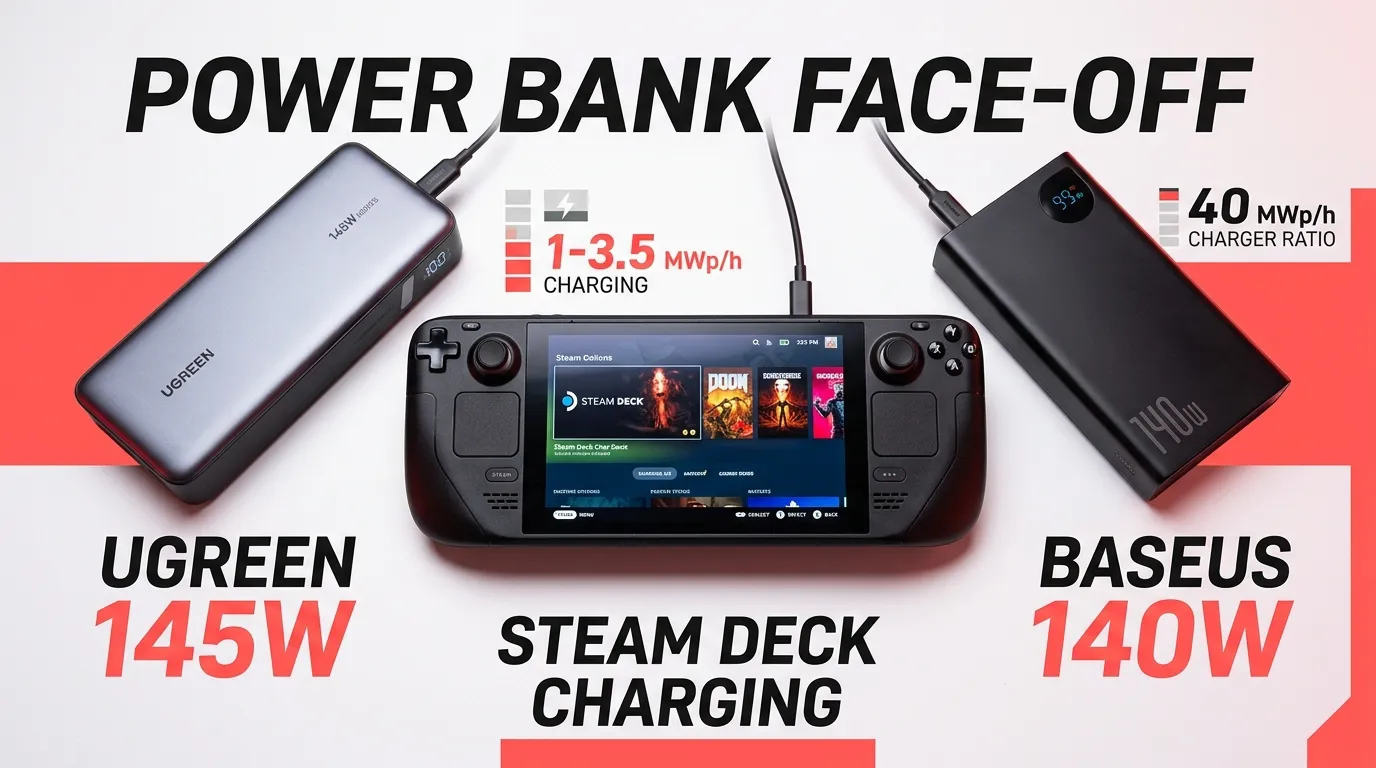
If you are choosing between the UGREEN 145W and Baseus 140W power banks for a Steam Deck, both have far more output than the Deck needs. The Steam Deck accepts up to 45W through USB-C Power Delivery, so the better choice depends less on the headline wattage and more on battery capacity, USB-C output, size, weight, and how you plan to use the bank.
The short answer
For most Steam Deck owners, UGREEN 145W is the better overall pick because its 25,000mAh/90Wh capacity gives you a strong balance of runtime and portability, and its USB-C1 port can provide up to 140W. UGREEN also explicitly lists Steam Deck compatibility and includes a 240W USB-C cable.
The Baseus 140W Adaman is still a strong alternative. It has a 24,000mAh/86.4Wh capacity, a 140W maximum USB-C output, a useful display, and a slightly smaller battery capacity than the UGREEN.
| Feature | UGREEN 145W | Baseus 140W Adaman |
|---|---|---|
| Nominal capacity | 25,000mAh / 90Wh | 24,000mAh / 86.4Wh |
| Maximum output | 145W total | 140W |
| Main USB-C output | Up to 140W | Up to 140W |
| USB-C ports | 2 | 2 |
| USB-A | Yes | Yes |
| Steam Deck compatibility | Listed by UGREEN | Listed by Baseus sellers |
| Display | Yes | Yes |
| Included USB-C cable | 240W | 240W |
| Best use | Steam Deck + other devices | Steam Deck + laptop/phone charging |
Why 145W vs. 140W does not matter much for Steam Deck
The biggest mistake in this comparison is assuming that the 145W model will charge a Steam Deck meaningfully faster.
It will not.
Valve specifies a 45W USB-C PD 3.0 power supply for the Steam Deck. That means the Deck itself does not need anything close to 140W or 145W from a power bank.
So, if both banks can provide a stable 45W-or-higher USB-C PD connection to the Deck, the extra 95–100W of theoretical capacity is mainly useful for other devices, not for making the Steam Deck charge at 140W.
This changes how you should compare these two power banks.
Instead of asking:
Which one has more watts?
Ask:
Which one gives me the best combination of Steam Deck charging, battery capacity, portability, and multi-device use?
On that basis, the UGREEN has a slight edge.
UGREEN 145W: why it makes sense for Steam Deck
The UGREEN 145W 25,000mAh power bank has a 90Wh nominal battery and three outputs. Its USB-C1 port supports up to 140W, while USB-C2 supports up to 65W and USB-A up to 22.5W.
That is much more capability than the Steam Deck requires, but it gives the UGREEN useful flexibility.
25,000mAh capacity
The UGREEN has a nominal capacity of 25,000mAh at 3.6V, or 90Wh. UGREEN lists its rated capacity at 14,500mAh/5V, which is a better reminder that the number printed on a power bank should not be treated as the exact amount of energy your Steam Deck will receive.
Power conversion creates losses, so you will not get 90Wh of usable energy at the Deck’s USB-C port.
Still, 90Wh gives the UGREEN a small capacity advantage over the Baseus 86.4Wh battery.
140W from one USB-C port
UGREEN’s USB-C1 supports up to 140W using PD 3.1. That’s useful if you also want the bank to power a compatible laptop.
For a Steam Deck, however, the important point is simpler: the port has plenty of headroom for the Deck’s 45W requirement.
That makes the UGREEN a good choice if you want one power bank for a Steam Deck, phone, tablet, and laptop.
240W cable included
UGREEN includes a 240W USB-C cable with this model.
You don’t need a 240W cable just to charge a Steam Deck at its 45W maximum, but having a suitable high-power USB-C cable is convenient if you later use the bank with a laptop.
Baseus 140W: where it stands out
The Baseus Adaman 140W is a 24,000mAh power bank with an 86.4Wh nominal capacity. Its USB-C1 supports up to 140W, while the other USB-C output has lower limits.
Baseus also specifically markets the bank for devices such as laptops and the Steam Deck.
Its capacity is close to UGREEN
The difference is small:
- UGREEN: 90Wh
- Baseus: 86.4Wh
That’s only a 3.6Wh difference on paper.
In real Steam Deck use, the actual difference will depend on conversion efficiency, charging conditions, battery health, game load, screen brightness, and other factors.
So don’t expect the UGREEN to give you a dramatically longer gaming session simply because it says 25,000mAh instead of 24,000mAh.
140W output is still plenty
The Baseus has a 140W maximum USB-C output, which is essentially irrelevant to the Deck’s 45W charging limit but useful for high-power laptops.
ChargerLAB’s testing of the Baseus 140W model identified the PPADM140 model and measured its 28V/5A 140W capability on USB-C1.
For Steam Deck use, the important thing is that the bank supports USB-C Power Delivery rather than whether its maximum number is 140W or 145W.
The display is useful
The Baseus has a digital display that can show information such as remaining battery level, voltage, and current.
That’s handy when you’re using a power bank with a handheld gaming device because you can see whether the bank still has plenty of charge without relying on a simple row of indicator lights.
Which one lasts longer with a Steam Deck?
UGREEN has the theoretical advantage because its battery is slightly larger.
Its 90Wh nominal capacity is about 4% greater than the Baseus’s 86.4Wh capacity.
But don’t interpret that as “4% more gaming time” in every situation. The Steam Deck’s own power consumption changes depending on the game, display settings, performance settings, and whether you’re charging while playing.
The original Steam Deck has a 40Wh battery, while the OLED model has a 50Wh battery. Valve lists gameplay ranges of 2–8 hours for the original model and 3–12 hours for the OLED model, depending on usage.
That makes both power banks substantial external batteries for a Steam Deck.
What about charging while gaming?
This is where a high-output USB-C power bank makes sense.
A Steam Deck can draw significant power while running a demanding game. Since Valve’s official power supply is rated at 45W, a power bank capable of delivering more than 45W through USB-C gives you enough output headroom for the Deck’s charging requirements.
But remember that 45W is the Deck’s charging input specification, not a promise that the console will constantly consume 45W from the bank.
A game running at a lower power level may draw much less.
For example, a lighter indie game and a demanding AAA game can have very different power demands. The power bank therefore does not determine your gaming battery life by wattage alone.
UGREEN 145W vs. Baseus 140W for Steam Deck OLED
For the Steam Deck OLED, I would still lean toward UGREEN 145W.
The OLED Deck has a larger 50Wh battery than the original Deck’s 40Wh battery, so a larger external battery is useful for longer trips. Valve also specifies the same 45W PD3.0 input for the OLED model.
That means the UGREEN’s slightly larger 90Wh battery is more useful than its extra 5W of headline output.
The difference between 145W and 140W is not the reason to choose UGREEN.
The capacity and overall port flexibility are more relevant.
Which is better for travel?
This depends on what you carry.
Both are relatively large laptop-class power banks rather than small phone power banks.
The Baseus 140W Adaman is listed at roughly 472.5g, while ChargerLAB measured an early PPADM140 sample at about 476g.
That is important because a large power bank plus a Steam Deck can add noticeable weight to a travel bag.
If your goal is simply to give your Steam Deck another short gaming session, you may not need a 24,000–25,000mAh power bank at all.
But if you are traveling for several hours and want one battery to handle your Steam Deck, phone, tablet, and possibly a laptop, the larger capacity becomes much more useful.
What about charging your phone at the same time?
Both models are designed for multiple devices.
The UGREEN has three outputs, including two USB-C ports and USB-A. Its second USB-C port supports up to 65W, while the USB-A port supports up to 22.5W.
The Baseus also has three output ports, but its power distribution changes when multiple ports are being used. The published specifications list combinations such as 100W + 15W when the primary USB-C port and another output are used together.
So if you want to play on the Steam Deck while charging a phone, check the multi-port power allocation rather than looking only at the 140W or 145W headline number.
That is one of the most important details in this comparison.
Two practical buying scenarios
If your Steam Deck is your main device
Choose UGREEN 145W if the prices are reasonably close.
Its slightly larger battery and strong USB-C output make it a well-rounded choice, and UGREEN explicitly lists Steam Deck among its compatible devices.
You do not need the full 145W output, but you get useful extra capability without sacrificing the ability to charge the Deck.
If you also carry a laptop
The decision becomes closer.
Both power banks offer much more USB-C power than the Steam Deck needs, so either can work as a shared battery for a handheld and laptop.
The Baseus is especially interesting if you value its digital display and find it substantially cheaper. Its 140W USB-C output is already enough for many high-power USB-C laptop charging scenarios.
In this situation, price and port-power behavior may matter more than the 5W difference.
A common mistake: buying based on 140W vs. 145W
If you’re buying specifically for a Steam Deck, don’t pay a large premium simply to move from 140W to 145W.
The Deck cannot suddenly charge at 140W or 145W.
Valve specifies a 45W USB-C PD power supply.
The extra output is useful for other devices, not for increasing the Deck’s maximum charging rate.
A better buying checklist is:
- Does the main USB-C port support USB-C PD?
- Can it provide at least 45W?
- How much usable battery energy does it provide?
- How much does it weigh?
- How does power get divided when multiple devices are connected?
- Is the price reasonable?
- Does it include an appropriate USB-C cable?
Both of these power banks score well on the first two points.
Is 24,000–25,000mAh too large for Steam Deck?
Not necessarily.
A large bank makes sense if you:
- Travel frequently with your Deck
- Take long flights or road trips
- Play away from outlets for several hours
- Carry other USB-C devices
- Want one battery for both gaming and work
- Need laptop-level charging capability
It may be excessive if you mostly play at home and have an outlet nearby.
In that case, a smaller and lighter power bank can be easier to carry.
One important travel detail
Both batteries are around or below the commonly used 100Wh threshold for portable lithium-ion batteries on flights: UGREEN lists 90Wh, while the Baseus is listed at 86.4Wh.
That makes them more practical for air travel than many very large power stations.
Still, airline policies can differ. Check your airline’s current carry-on rules before flying rather than assuming that a capacity rating automatically guarantees approval.
UGREEN 145W or Baseus 140W: final verdict
For Steam Deck use, I would choose the UGREEN 145W.
The reason is not the extra 5W. That difference is basically irrelevant to the Steam Deck.
UGREEN gets the edge because it combines a slightly larger 90Wh battery, 140W single-port USB-C output, three charging ports, a digital display, and an included 240W USB-C cable. UGREEN also explicitly lists Steam Deck compatibility.
The Baseus 140W Adaman remains a very good alternative, especially if you find it at a noticeably lower price or prefer its compact design and display. Its 86.4Wh capacity is close to UGREEN’s 90Wh, and its 140W USB-C output is already far beyond what the Steam Deck requires.
For a Steam Deck buyer, the ranking is therefore simple:
| Category | Winner |
|---|---|
| Steam Deck charging | Tie |
| Maximum output | UGREEN |
| Battery capacity | UGREEN |
| Port flexibility | UGREEN |
| Display | Tie |
| Value at a lower sale price | Baseus can win |
| Best overall for Steam Deck | UGREEN 145W |
The practical tip is to choose based on battery capacity, weight, price, and multi-device power distribution—not the 5W difference. The Steam Deck itself is designed around 45W USB-C PD charging, so both banks already have plenty of charging headroom.
Frequently Asked Questions
Can a 140W or 145W power bank damage a Steam Deck?
No, not simply because the power bank is rated for 140W or 145W. The Steam Deck and USB-C Power Delivery system negotiate the power they need, and Valve specifies a 45W PD power supply for the Deck.
Does UGREEN 145W charge the Steam Deck faster than Baseus 140W?
Not in any meaningful way. The Steam Deck’s charging input is rated at 45W, so both power banks have substantially more output capability than the Deck can use.
Is UGREEN 145W worth buying just for a Steam Deck?
It can be, especially if you want a large travel battery that can also charge phones, tablets, or laptops. If you only need extra Steam Deck runtime and do not need laptop-level output, a smaller power bank may be a more practical choice.
Conclusion
For most Steam Deck owners, the UGREEN 145W is the better overall choice between these two power banks. Its slightly larger 90Wh capacity, strong USB-C output, and flexible port setup make it a practical option for longer gaming sessions and charging other devices.
The Baseus 140W is still a good pick if you find it at a lower price or prefer its design and display. Just remember that the Steam Deck itself only needs up to 45W USB-C PD, so the 140W vs. 145W difference should not be the deciding factor. Focus on capacity, weight, price, and how many devices you plan to charge.