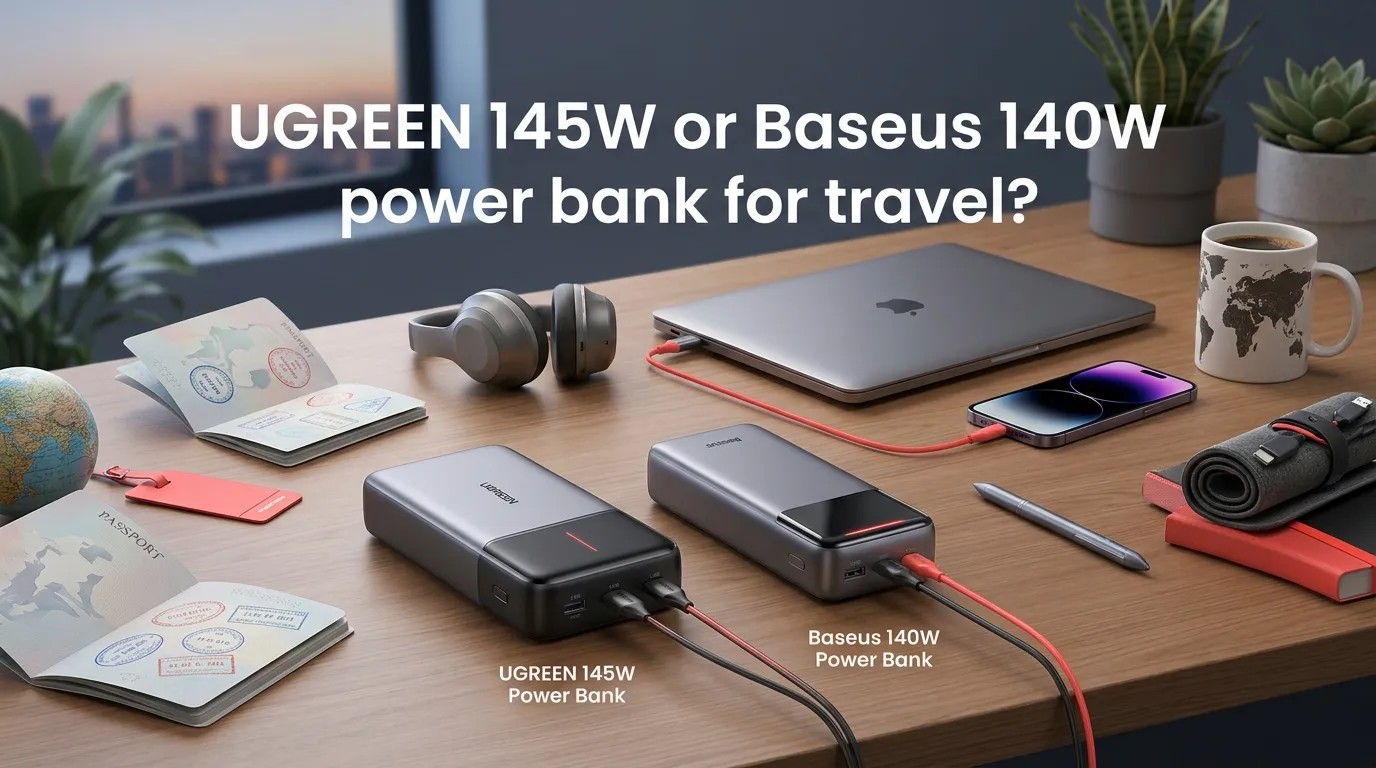
UGREEN 145W or Baseus 140W power bank for travel?

If you want one high-power power bank for travel, the UGREEN 145W 25,000mAh is the better overall choice for most laptop travelers. It has a larger 90Wh battery, a 140W USB-C output, three charging ports, and a clear battery display. The Baseus Adaman 140W 24,000mAh is a strong alternative if you prefer faster 100W recharging and a slightly lower capacity.
For this comparison, the relevant Baseus model is the Adaman 140W 24,000mAh. It is different from some newer Baseus power banks that also advertise 140W or 145W output.
UGREEN 145W vs. Baseus 140W at a glance
| Feature | UGREEN 145W | Baseus Adaman 140W |
|---|---|---|
| Battery capacity | 25,000mAh | 24,000mAh |
| Energy rating | 90Wh | 86.4Wh |
| Maximum output | 140W from USB-C | 140W |
| USB-C ports | 2 | 2 |
| USB-A | Yes | Yes |
| Devices at once | Up to 3 | Up to 3 |
| Digital display | Yes | Yes |
| Recharge input | Up to 65W | Up to 100W |
| Air travel | Under 100Wh | Under 100Wh |
| Best for | Long travel and laptop use | Faster power-bank recharge |
UGREEN lists the 145W model at 25,000mAh/90Wh, with 140W maximum output from its primary USB-C port, 65W from the second USB-C port, and 22.5W from USB-A. Baseus lists its Adaman model at 24,000mAh with 140W maximum output, 100W maximum recharge input, two USB-C ports, and one USB-A port.
Why the UGREEN 145W is better for most travelers
The biggest advantage is not the extra 5W in the product name. In real travel use, the more important difference is the 25,000mAh, 90Wh battery.
UGREEN’s pack has 90Wh of energy, compared with 86.4Wh for the 24,000mAh Baseus model. That gives UGREEN a small capacity advantage while both remain below the FAA’s 100Wh threshold for spare lithium-ion batteries carried by passengers.
For a traveler carrying a laptop, phone, earbuds, tablet, or handheld gaming device, that extra capacity can be useful during a long travel day.
UGREEN also gives you:
- 140W maximum USB-C output
- 65W second USB-C output
- 22.5W USB-A output
- Three ports
- A digital percentage display
- A 240W USB-C cable included
- 513g weight
- 160 × 80 × 26mm dimensions
The 513g weight is worth noticing. This is a high-capacity laptop power bank, not a small phone-only battery.
Where Baseus has the advantage
Baseus has one particularly useful advantage for travelers: 100W input.
The Adaman 140W supports up to 100W recharging, while UGREEN’s 145W model lists up to 65W input. Baseus says its 24,000mAh model can recharge in about an hour with a sufficiently powerful charger, while UGREEN specifies about two hours using a 65W PD charger.
That matters if you have access to an outlet during a hotel stay, airport layover, or work session and want to refill the power bank quickly before heading out again.
Baseus also supports charging three devices simultaneously and includes a digital display. Its advertised charging protocols include PD 3.1, PD 3.0, QC 4.0, QC 3.0, PPS, and other protocols.
UGREEN 145W vs. Baseus 140W for airplane travel
Both are suitable sizes for airline travel based on their stated energy ratings. UGREEN’s battery is rated at 90Wh, while the Baseus model is 86.4Wh. Both are below the FAA’s standard 100Wh limit for spare lithium-ion batteries.
But there is an important rule travelers should not overlook: power banks must be carried in your carry-on baggage or personal item, not checked baggage. The FAA specifically treats power banks as spare lithium batteries.
TSA guidance also says power banks belong in carry-on bags and not checked luggage.
Airline policies can be stricter than the general FAA/TSA limits, so check your airline before a flight, especially for international trips.
Is 90Wh too large for travel?
No. A 90Wh power bank is below the standard 100Wh threshold.
In fact, UGREEN specifically markets its 25,000mAh model as airline-friendly, and its official specification gives the battery rating as 90Wh.
Still, keep it accessible in your carry-on. Don’t bury it inside checked luggage.
Which one is better for laptops?
UGREEN gets the edge for overall laptop travel use.
Both can deliver up to 140W, but the exact charging speed you receive depends on your laptop, cable, and USB Power Delivery support.
For example, a laptop that only accepts 65W will not suddenly charge at 140W because the power bank can provide 140W. The laptop controls how much power it requests.
UGREEN’s primary USB-C port supports up to 140W and uses PD 3.1, while the second USB-C port can provide up to 65W.
Baseus also uses PD 3.1 and supports up to 140W output. Baseus says its included 240W USB-C cable supports the requirements for 140W charging.
For a USB-C laptop that supports high-power PD charging, either can be a capable travel companion.
Which is better for charging multiple devices?
This is a closer contest.
UGREEN provides:
- USB-C1: up to 140W
- USB-C2: up to 65W
- USB-A: up to 22.5W
That gives you three useful ports for a laptop, phone, and smaller accessory.
Baseus also has two USB-C ports and one USB-A port and supports charging three devices simultaneously.
If your travel kit is something like a MacBook, iPhone, and earbuds, either model makes sense.
The important point is that maximum output is not necessarily available to every port at the same time. When multiple devices are connected, available power is distributed according to the power bank’s charging system and the devices’ requirements.
Which one is easier to manage while traveling?
UGREEN has a practical advantage here: its display makes the remaining charge easy to check.
Instead of relying on a few indicator lights, you can see the battery percentage directly. That’s useful when you’re leaving a hotel or boarding a flight and want to know whether you have enough backup power.
Baseus also has a smart digital display and can show remaining power and charging information.
So there is no major winner in this area.
What about size and weight?
For travel, capacity is only part of the equation. You also have to carry the thing.
UGREEN’s official specifications list the 145W model at 513g and 160 × 80 × 26mm.
The Baseus Adaman is designed as a compact laptop power bank, but the current official product page that previously listed the 140W model is no longer available, so I would not rely on an unverified third-party dimension or weight figure.
That is one reason to be careful when comparing these products online: different Baseus 140W/145W models have appeared over time, and their capacities and physical designs are not identical.
A practical travel scenario
Imagine you’re taking a long domestic flight and carrying a USB-C laptop, phone, and wireless earbuds.
With UGREEN, you could use the high-power USB-C port for the laptop, the second USB-C port for your phone, and USB-A for another small device. The 90Wh capacity gives you a substantial amount of stored energy without crossing the FAA’s standard 100Wh threshold.
Now consider a different situation: you arrive at a hotel with a nearly empty power bank and need to leave again soon.
That’s where Baseus becomes more attractive. Its 100W maximum input can make a significant difference when you have a compatible high-power USB-C charger available.
UGREEN 145W or Baseus 140W: which should you buy?
For most travelers, I’d choose UGREEN 145W.
It has the slightly larger battery, a 90Wh airline-friendly rating, strong 140W USB-C output, three ports, a useful digital display, and a well-documented 513g/160 × 80 × 26mm design.
Choose Baseus 140W instead if fast recharging of the power bank itself matters more to you. Its 100W input is the standout feature, especially for travelers who regularly have short periods near an outlet.
Choose UGREEN if:
- You want the larger battery.
- You regularly travel with a laptop.
- You want 90Wh of capacity while staying below the standard 100Wh threshold.
- You want a clearly documented physical size and weight.
- You want three ports and a percentage display.
- You value extra battery capacity more than ultra-fast recharge.
Choose Baseus if:
- You want faster power-bank recharging.
- You have a 100W USB-C charger available.
- You prefer the Adaman’s port arrangement and design.
- You find it at a substantially lower price.
- Your main concern is getting the battery back to full quickly between travel sessions.
One detail travelers should not overlook: the charger
A 140W power bank does not mean the power bank itself will recharge at 140W.
UGREEN’s 145W model accepts up to 65W input, while Baseus’s Adaman 140W model supports up to 100W input.
So if you buy UGREEN and already own a 65W USB-C PD charger, you can take advantage of its stated recharge capability.
If you choose Baseus, a compatible 100W charger can make its faster recharge feature useful.
Your USB-C cable also matters. High-power USB-C charging requires a cable that supports the needed power level. Baseus specifically notes that its included 240W cable supports PD 3.1, while UGREEN includes a 240W USB-C cable with its current US listing.
What does the 145W vs. 140W difference actually mean?
Very little for most travelers.
The five-watt difference in the product names should not be the main reason you choose one.
The more meaningful differences are:
- UGREEN has 25,000mAh/90Wh capacity.
- Baseus has 24,000mAh/86.4Wh capacity.
- Both offer up to 140W high-power output.
- Baseus supports faster 100W input.
- UGREEN’s physical specifications are clearly documented at 513g and 160 × 80 × 26mm.
In other words, don’t buy UGREEN simply because “145W” sounds faster. The actual maximum USB-C output on UGREEN’s primary port is 140W.
Frequently Asked Questions
Is the UGREEN 145W power bank allowed on airplanes?
Yes, its stated 90Wh capacity is below the FAA’s standard 100Wh limit for spare lithium-ion batteries. However, power banks must be carried in your carry-on baggage or personal item, not checked luggage, and your airline may impose additional restrictions.
Is Baseus 140W better than UGREEN 145W for laptops?
Not necessarily. Both can provide up to 140W through USB-C, so the better choice depends more on capacity, recharge speed, size, price, and your laptop’s actual charging requirement than on the 5W difference in their names.
Which power bank is better for long trips?
The UGREEN 145W is the better overall pick for long trips because its 25,000mAh battery provides slightly more stored energy than the 24,000mAh Baseus. If you frequently have short charging windows and need to refill the power bank quickly, Baseus’s 100W input can make it the better fit.
Final verdict
For a US traveler who wants one powerful power bank for a laptop, phone, tablet, or other USB-C devices, UGREEN 145W is the better overall travel choice.
Its 25,000mAh/90Wh capacity gives it a small endurance advantage, while its 140W USB-C output is already enough for many high-power USB-C laptops. The three-port layout and percentage display also make it practical for travel days.
Baseus 140W is the better specialist choice if fast recharge matters most. Its 100W input is the feature to focus on, not the difference between 140W and 145W output.
One practical tip: before flying, check the Wh rating printed on your specific power bank and your airline’s current battery rules, then keep the power bank in your carry-on. FAA guidance confirms that spare power banks cannot go in checked baggage.